How to Convert Units in Your Head: Mental Math Tricks That Are Close Enough
You don’t always have a converter open. At a market abroad, reading a foreign weather forecast, or skimming a recipe, what you need is a number that’s roughly right, right now. These are the mental shortcuts worth memorizing — each within a few percent — and, just as important, the situations where estimating is the wrong move. For exact figures, the unit converter is one tab away.
Open the Unit Converter →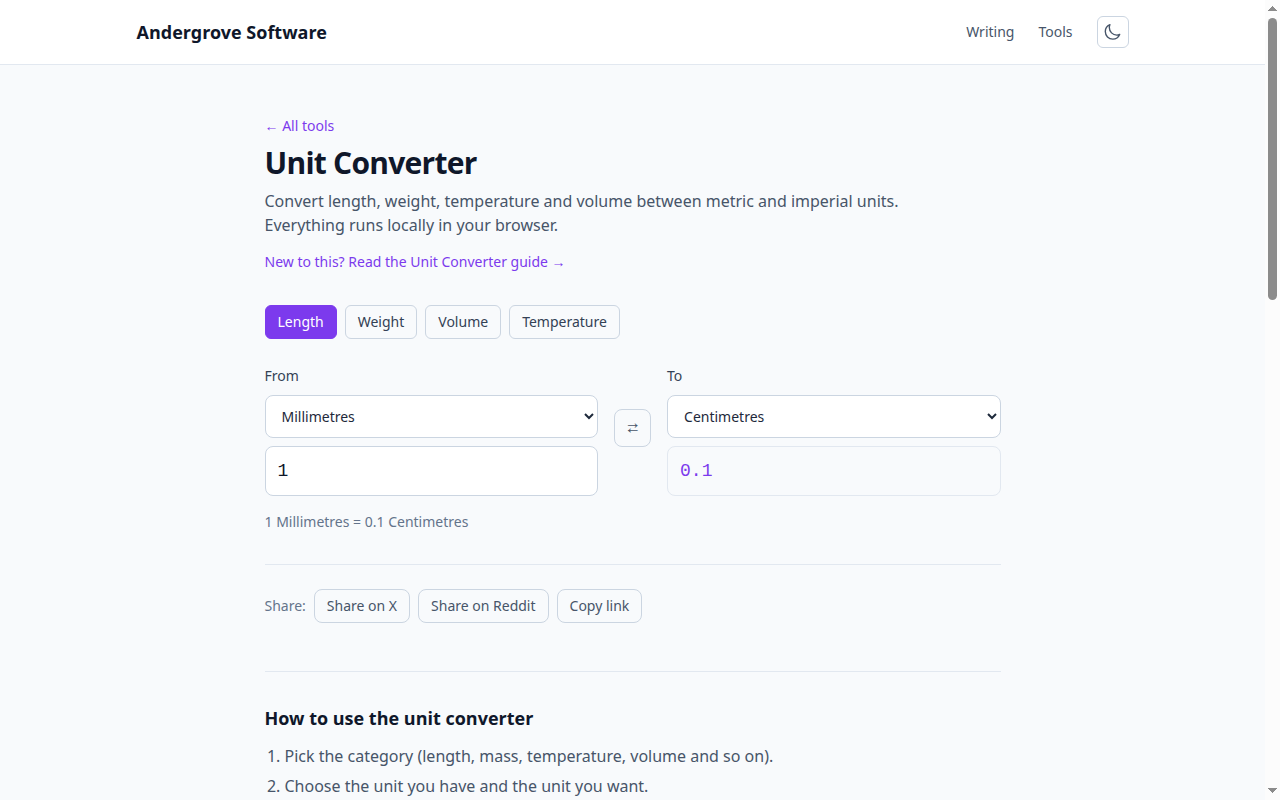
Distance: miles, kilometers, meters and feet
Kilometers to miles: multiply by 0.6 (the true factor is 0.621). A pleasant coincidence makes consecutive Fibonacci numbers work too: 5 km ≈ 3 miles, 8 km ≈ 5 miles, 13 km ≈ 8 miles — because the Fibonacci ratio (~1.618) sits almost exactly on the km-per-mile factor (1.609). Meters to feet: triple it and add 10% — 10 m → 30 + 3 = 33 ft (true answer 32.8). Centimeters to inches: divide by 2.5 in your head and shave a little off, since the real divisor is 2.54. The exact factors, with worked tables, live on the meters-to-feet and kilometers-to-miles pages.
Weight: kilos, pounds and stone
Kilograms to pounds: double it, then add 10% of the doubled number — 70 kg → 140 + 14 = 154 lb (true answer 154.3, since the factor is 2.2046). Pounds to kilograms: run it backwards — halve, then knock 10% off: 150 lb → 75 − 7.5 ≈ 68 kg. British stone is just pounds ÷ 14, so 154 lb is 11 st on the nose. These two shortcuts cover most travel, gym and cooking situations without touching a calculator.
Temperature: the one that isn’t a multiplication
Temperature is the trap: Celsius and Fahrenheit don’t share a zero, so you can’t just scale. The exact rule is °F = °C × 1.8 + 32; the mental version is "double it and add 30" — 20 °C → 70 °F (true answer 68). The shortcut is tightest around everyday weather (0–30 °C) and drifts about a degree for every five you move away from 10 °C, so don’t use it for ovens or fevers. Two anchors keep you oriented: 37 °C is body temperature (98.6 °F), and −40 is the crossover where both scales agree. Full tables are on the Celsius-to-Fahrenheit page.
Kitchen volumes: cups, tablespoons, milliliters
Anchor on three numbers: a US cup is about 240 ml, a tablespoon 15 ml, a teaspoon 5 ml. Everything else in a recipe is arithmetic on those — half a cup is 120 ml, a quarter is 60. The real kitchen hazard isn’t rounding; it’s which cup: US, UK and Australian cups genuinely differ (240 / 284 / 250 ml), and an Australian tablespoon is 20 ml, not 15. In baking, where ratios rule, check whose cup the recipe author meant before you scale anything.
When "close enough" isn’t
Mental factors are for orientation, not commitment. Medication doses, engineering tolerances, fuel calculations and anything legal or financial deserve the exact factor and a written-down answer. The cautionary tale is famous for a reason: in 1999 NASA lost the Mars Climate Orbiter because one team’s software produced thrust figures in pound-force units while another’s expected metric newtons — a conversion nobody made, on a spacecraft nobody could refund. The rule of thumb: estimate to decide, convert exactly to act. When it’s time to act, the unit converter covers length, weight, temperature and volume with the precise factors.
Ready to try it? Open the Unit Converter →