Beyond BMI: What a 200-Year-Old Formula Can and Can’t Tell You About Health
BMI was never designed to judge individuals. It began in the 1830s when the Belgian statistician Adolphe Quetelet went looking for the proportions of the "average man" across a population — and nearly two centuries later his ratio ended up on your doctor’s clipboard. It’s a genuinely useful screening number with well-mapped blind spots, and a few better companions. Check your own number with the BMI calculator, then read on for what to do with it.
Open the BMI Calculator →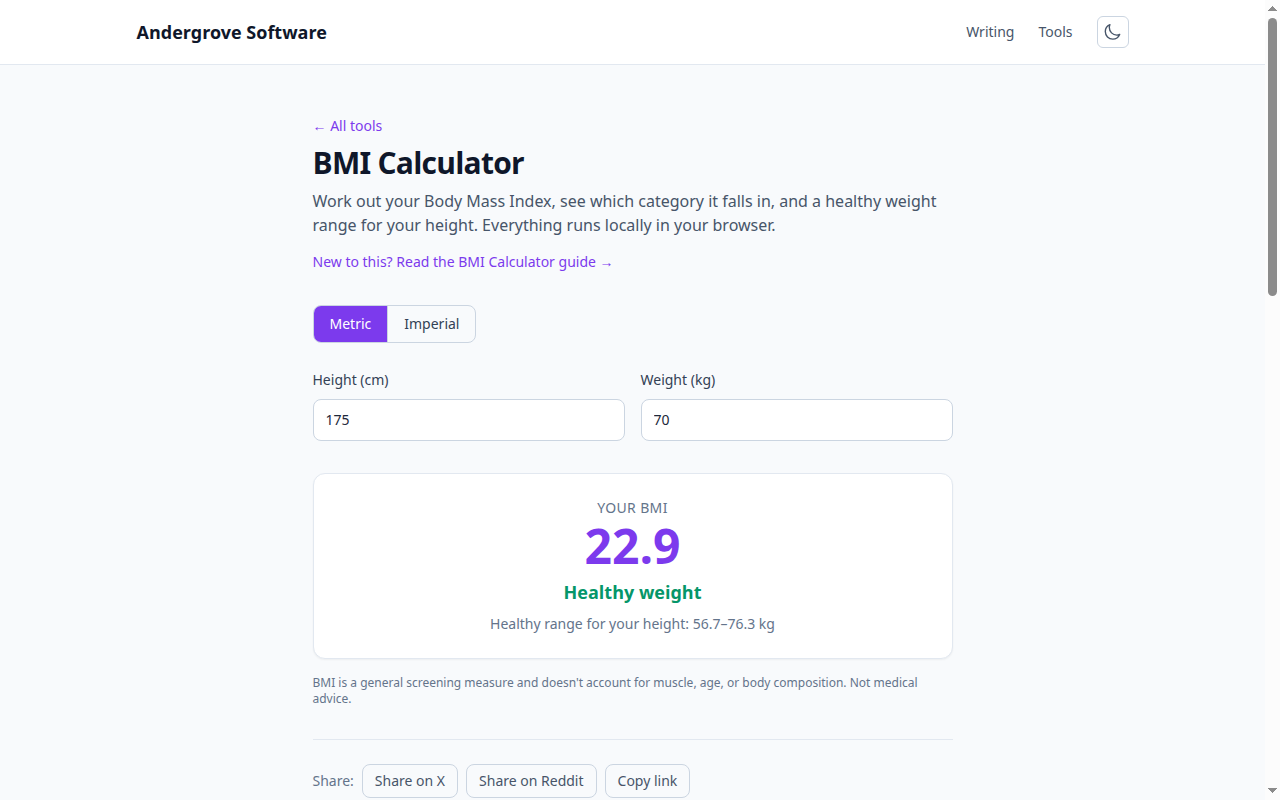
How a census statistic became a health label
Quetelet’s weight-over-height-squared ratio was built to describe populations, not to diagnose anyone. It picked up the name "body mass index" in 1972, when the physiologist Ancel Keys found it the least-bad of the simple height-weight indices for population studies — and explicitly not a substitute for measuring body fat. Insurers and health systems adopted it anyway, because it costs nothing and needs only a scale and a tape measure. That’s the honest status of BMI today: a cheap, standardized screening number whose thresholds (18.5, 25, 30) mark statistical risk zones across large groups, not verdicts on individuals.
The blind spots, concretely
BMI sees total mass, not what it’s made of or where it sits. Muscle is denser than fat, so strength athletes and heavy-training rugby players routinely read "overweight" while carrying less fat than the average person. It misses the reverse case too: a normal-BMI person with little muscle and central fat — the pattern most associated with metabolic trouble — sails through the screen. Risk thresholds also shift with ancestry: WHO guidance notes that many Asian populations see elevated metabolic risk from around BMI 23, well under the standard 25 cutoff. And in older adults, a slightly higher BMI often tracks with better outcomes, partly because it can signal preserved muscle.
The measurements that add the missing information
Where fat sits matters more than how much you weigh, and the tape measure captures it. Waist-to-height ratio is the standout for effort-to-value: keep your waist under half your height, a rule that holds up remarkably well across sexes and ethnicities and often flags risk BMI misses. Waist circumference alone works too (commonly cited alert zones: ~94 cm/37 in for men, ~80 cm/31.5 in for women, measured at the navel after a normal exhale). Body-fat percentage is the most direct answer, but casual methods (smart scales, hand-held devices) swing several points with hydration — trend them, don’t trust any single reading.
How to actually use these numbers
Use BMI the way it was built to be used: as one population-calibrated flag among several, and as a trend over months rather than a daily verdict. A sensible personal dashboard is BMI + waist-to-height + how your fitness is moving (resting heart rate, what you can lift or run) — three cheap numbers that cover each other’s blind spots. If they disagree, the tape measure usually outranks the scale. And none of them outranks an actual clinician: the calculators, this one included, are for orientation, not diagnosis. The BMI calculator takes metric or imperial inputs — and if you need to translate between the two first, the unit converter covers it.
Ready to try it? Open the BMI Calculator →