UTC, GMT and Time Zone Abbreviations, Explained
Most cross-time-zone mistakes come from three traps: treating GMT and UTC as interchangeable when it matters, trusting an ambiguous abbreviation like IST or CST, and forgetting that daylight saving moves the target twice a year. This guide clears up all three.
Open the Time Zone Converter →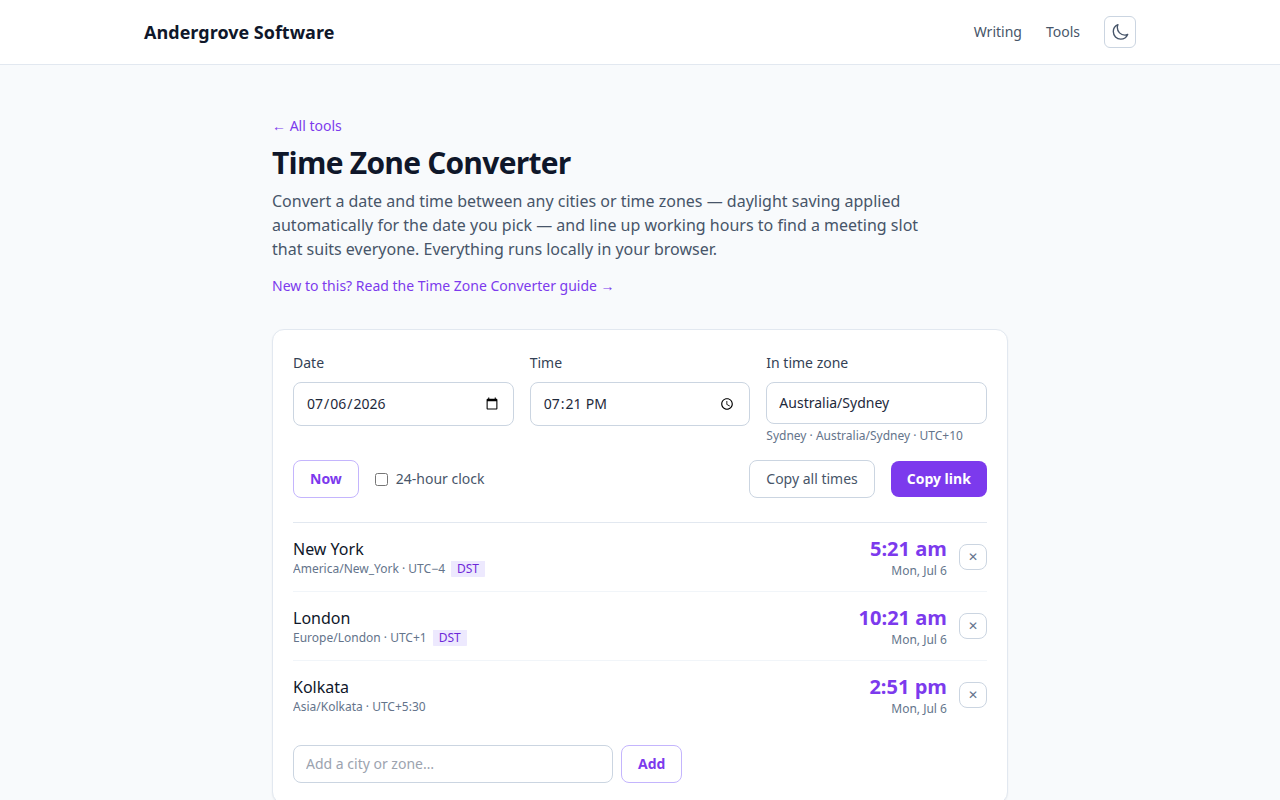
UTC vs. GMT: same clock, different ideas
For everyday scheduling, UTC and GMT show the same time. But they are different kinds of thing. GMT (Greenwich Mean Time) is a time zone — the local time at zero longitude, used in the UK in winter. UTC (Coordinated Universal Time) is the international reference standard that all zones are defined against — a precise atomic-clock scale, not a place. Engineers, pilots and server logs use UTC; "GMT" survives mostly as a label in Britain and in legacy software.
The practical trap: the UK is not on GMT year-round. In summer it switches to BST (UTC+1). "Let's sync at 3pm GMT" said in July by a Londoner usually means 3pm BST — an hour away from what the words say. When precision matters, say UTC and mean it.
Offsets: why +5:30 and +5:45 exist
Every zone is defined as an offset from UTC. Most are whole hours, but nothing requires that: India runs at UTC+5:30, Iran at +3:30, and Nepal at +5:45 — offsets chosen so local noon roughly matches the sun while keeping one zone per country. At the extremes, the Line Islands sit at UTC+14, which is why Kiribati celebrates New Year first, a full 26 hours before the last islands at UTC−12.
Offsets also explain why the day of the week changes when you cross zones: 9pm Tuesday in Los Angeles is already 2pm Wednesday in Sydney. A good converter shows that day shift explicitly (ours badges it as +1 day) because "Wednesday" is the part people get wrong far more often than the hour.
The abbreviation trap: three ISTs, two CSTs
Three-letter zone abbreviations are not unique, and the collisions are exactly where international scheduling happens:
- IST — Indian Standard Time (UTC+5:30), Israel Standard Time (UTC+2), and Irish Standard Time (UTC+1).
- CST — US Central (UTC−6), China Standard Time (UTC+8), and Cuba Standard Time (UTC−5).
- BST — British Summer Time (UTC+1) or Bangladesh Standard Time (UTC+6).
- AMT, AST, ECT, GST… — the list of duplicates is long.
The fix used by every serious system is the IANA time zone database, which names zones by region and city: Asia/Kolkata, America/Chicago, Europe/Dublin. A city can only be in one place, and the database carries every zone's full history of offset and DST rule changes. Our time zone converter accepts the familiar abbreviations, but it resolves and displays the IANA name so you can see exactly which interpretation you got.
EST vs. EDT, and other daylight saving confusion
"EST" and "EDT" are the same place at different times of year: Eastern Standard Time (UTC−5, winter) and Eastern Daylight Time (UTC−4, summer). Saying "EST" in July technically names a time nobody in New York is observing. Most people mean "New York time, whatever it currently is" — which is exactly what the IANA zone America/New_York denotes, and another reason city-based zones beat abbreviations.
Daylight saving adds two sharper traps. First, different hemispheres shift in opposite directions: when the US springs forward, Sydney is falling back, so the New York–Sydney gap changes by two hours across a few weeks, not one. Second, shift dates differ even between aligned countries — the US and Europe change several weeks apart, so every March and October/November there is a window where the usual London–New York gap is wrong. Recurring meetings booked as "same local time" quietly move for everyone else during those windows.
Scheduling across zones without mistakes
Rules that prevent almost every incident:
- Name the city, not the abbreviation: "9am New York time" is unambiguous; "9am EST" is wrong half the year and ambiguous always.
- State the date with the time — the day may differ at the other end.
- For anything automated, store UTC and convert for display; our Unix timestamps guide covers why.
- Check the working-hours overlap before proposing a slot. A three-city call between San Francisco, London and Singapore has essentially no shared business hours — better to know before you propose 8am.
- Re-check recurring meetings in March and October, when staggered DST changes silently move them for someone.
The converter automates the fiddly parts: it applies the right DST rules for the specific date, badges day rollovers, and lays out each city's working hours so the least-bad slot is visible at a glance.
Ready to try it? Open the Time Zone Converter →