Sinking Funds: How to Save for Big Expenses Without Wrecking Your Budget
The car insurance renewal, the holiday, the new laptop — none of these are surprises, yet they land like emergencies because they arrive as one big bill. The fix is a technique old-school accountants call a sinking fund: turn every large planned expense into a small automatic monthly payment to yourself, months before the bill exists. Here’s the whole method. The savings goal calculator does the divide-and-schedule arithmetic for any goal.
Open the Savings Goal Calculator →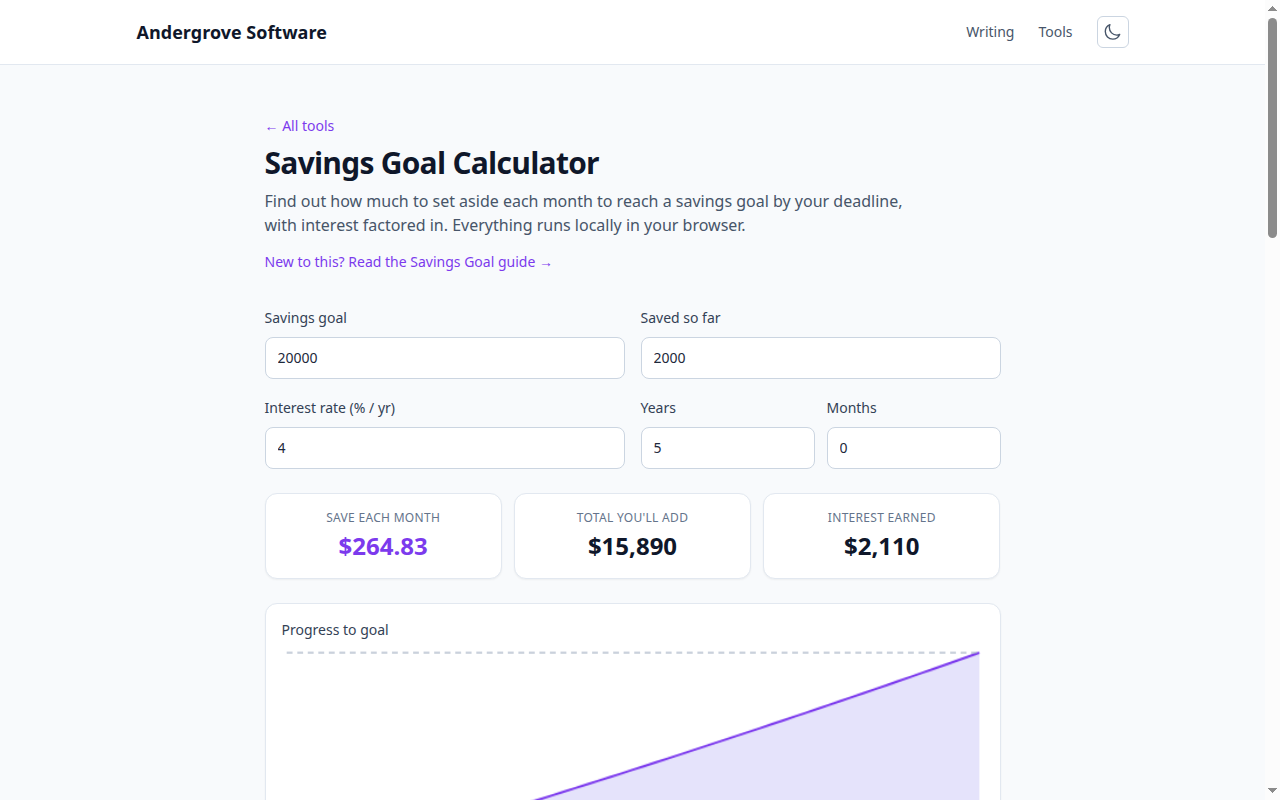
The method in one line
Amount ÷ months until you need it = what to put away each month. A $1,200 insurance renewal due in twelve months is $100 a month; a $3,000 summer trip eighteen months out is $167. The power isn’t in the arithmetic — it’s in the reframe: the expense stops being a future shock and becomes a boring line item you’ve already handled. When interest can help (longer horizons), the required monthly amount drops a little below the straight division; the calculator shows both the plan and the year-by-year path.
Name the buckets, and keep them separate
A sinking fund works because the money has a job title. One undifferentiated savings account quietly becomes an everything fund that anything can raid; a bucket labeled "Car repairs" psychologically belongs to the car. Most banks now offer sub-accounts, "pots" or "spaces" for exactly this — one per goal, each with its own target and date. Typical household buckets: annual insurance premiums, car maintenance (repairs are planned expenses that merely haven’t scheduled themselves), holidays, gifts in December, tech replacement, and next year’s vacation. Five buckets of $40 hurt less than one $200 crisis — because they’re the same money without the panic.
Automate on payday, not on willpower
Set every bucket’s transfer to fire the day after your pay lands, before discretionary spending sees the money. This is "pay yourself first" in mechanical form: saving that depends on end-of-month leftovers competes with every restaurant in town and loses. If the total across buckets doesn’t fit your budget, don’t shrink the automation habit — shrink or postpone a goal explicitly. A sinking fund that’s honestly too slow is still building; one you skip "just this month" has a way of becoming decorative.
Where to park the money (and what not to do)
Match the vehicle to the horizon. Money needed within a year or three belongs somewhere boring and instant: a high-yield savings account or equivalent, where the only job is being there on the day. The stock market is the wrong place for short-horizon goals — a 20% dip the month before your wedding is a real scenario, not a hypothetical. Compounding only becomes a meaningful teammate on long horizons (see how compound interest works for why time is the active ingredient). Two boundary notes: an emergency fund is not a sinking fund — it’s for the genuinely unplannable, and raiding it for known expenses defeats both tools; and if you’re carrying high-interest debt, run the payoff-vs-save comparison honestly — the debt payoff calculator makes the interest cost concrete.
Ready to try it? Open the Savings Goal Calculator →