Simple vs Compound Interest: The Difference, with Examples
Simple and compound interest sound similar but grow very differently, and the difference decides how fast savings build or debt spirals. This guide explains both with the formulas and worked numbers, and shows why compounding is "the eighth wonder of the world" over long periods. Try your own figures in the compound interest calculator.
Open the Compound Interest Calculator →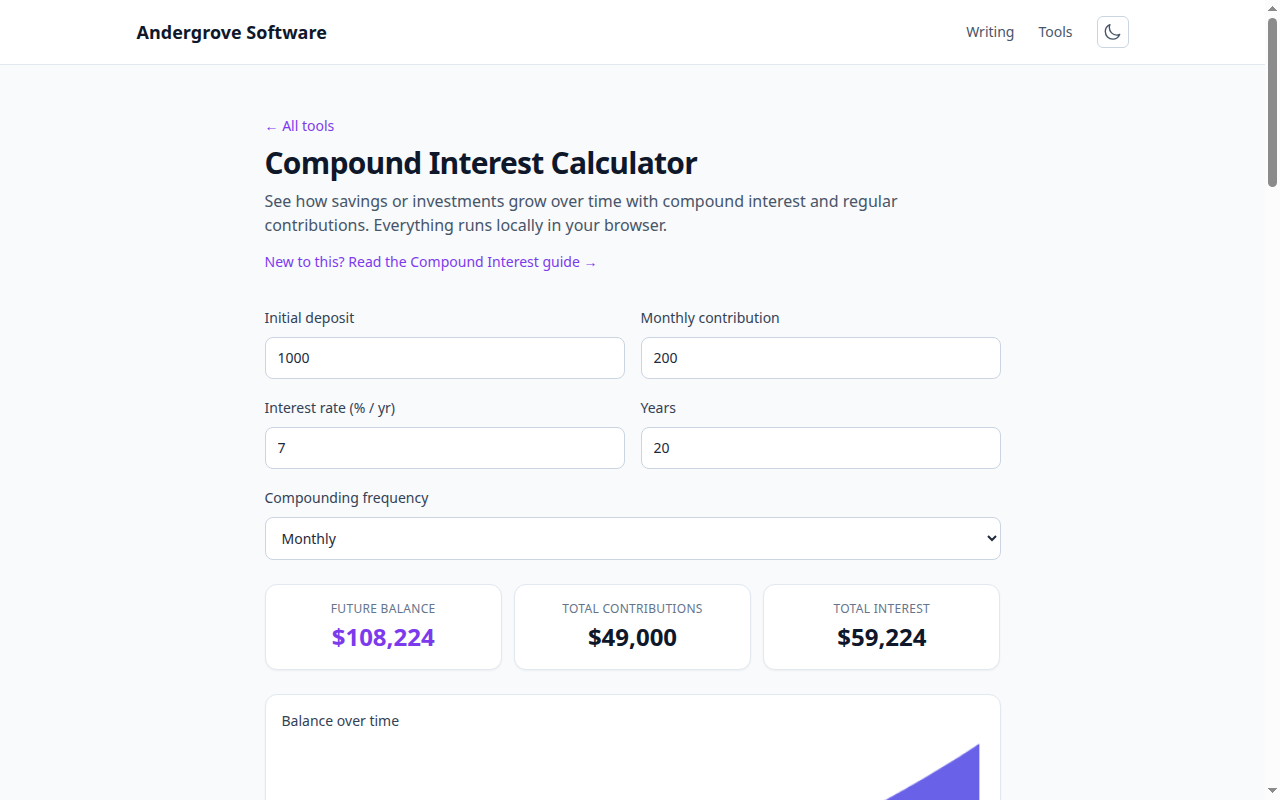
Simple interest
Simple interest is charged only on the original amount (the principal), never on the interest already earned. The formula is:
Interest = P · r · twhere P is the principal, r the annual rate and t the number of years. Put $10,000 at 5% simple interest for 10 years and you earn 10,000 × 0.05 × 10 = $5,000, for a total of $15,000. Every year adds the same $500 — a straight line. Simple interest shows up in some short-term loans and bonds.
Compound interest
Compound interest is charged on the principal and on the interest accumulated so far, so it grows on itself. The formula is:
A = P · (1 + r/n)^(n·t)where n is how many times a year interest compounds. The same $10,000 at 5% compounded annually for 10 years becomes 10,000 × 1.05^10 ≈ $16,289 — about $1,289 more than simple interest, because each year's interest starts earning its own interest. The growth curve bends upward instead of running straight.
Why the gap widens over time
Over a few years the difference is modest; over decades it is enormous, because compounding feeds on itself. Extend that $10,000 at 5% to 30 years: simple interest gives $25,000 total, but compound gives about $43,219. The longer the time horizon, the more the compound curve pulls away — which is exactly why starting to save early matters far more than the amount, as covered in how compound interest works.
Compounding frequency
The more often interest compounds — annually, monthly, daily — the slightly more you earn, because interest starts earning sooner. On our example, monthly compounding instead of annual nudges the 10-year result from about $16,289 to $16,470. The effect is real but small compared with the rate and the time; do not chase daily-vs-monthly and ignore a better rate or an extra decade. A useful shortcut is the Rule of 72: divide 72 by the rate to estimate the years to double your money — at 6%, about 12 years.
It cuts both ways
Compounding builds wealth in a savings account and buries you in credit-card debt, by the same mechanism. A balance at 20% APR that compounds monthly grows alarmingly if you pay only the minimum, because unpaid interest is added to the balance and then charged interest itself. Understanding compounding is as much about escaping high-interest debt quickly as about saving — see the debt payoff calculator.
Run the numbers
The compound interest calculator projects a balance from a starting amount, a rate, a time horizon and optional monthly contributions, with a growth chart and a year-by-year table so you can see the curve bend. It runs entirely in your browser.
Ready to try it? Open the Compound Interest Calculator →