The 4% Rule Explained: How Much You Need to Retire
"How much do I need to retire?" has a surprisingly simple starting answer: the 4% rule. It is a rule of thumb, not a guarantee, but it turns a vague fear into a concrete number you can plan toward. This guide explains where it comes from, how to use it, and when to be more cautious. Project your own savings in the retirement calculator.
Open the Retirement & 401(k) Calculator →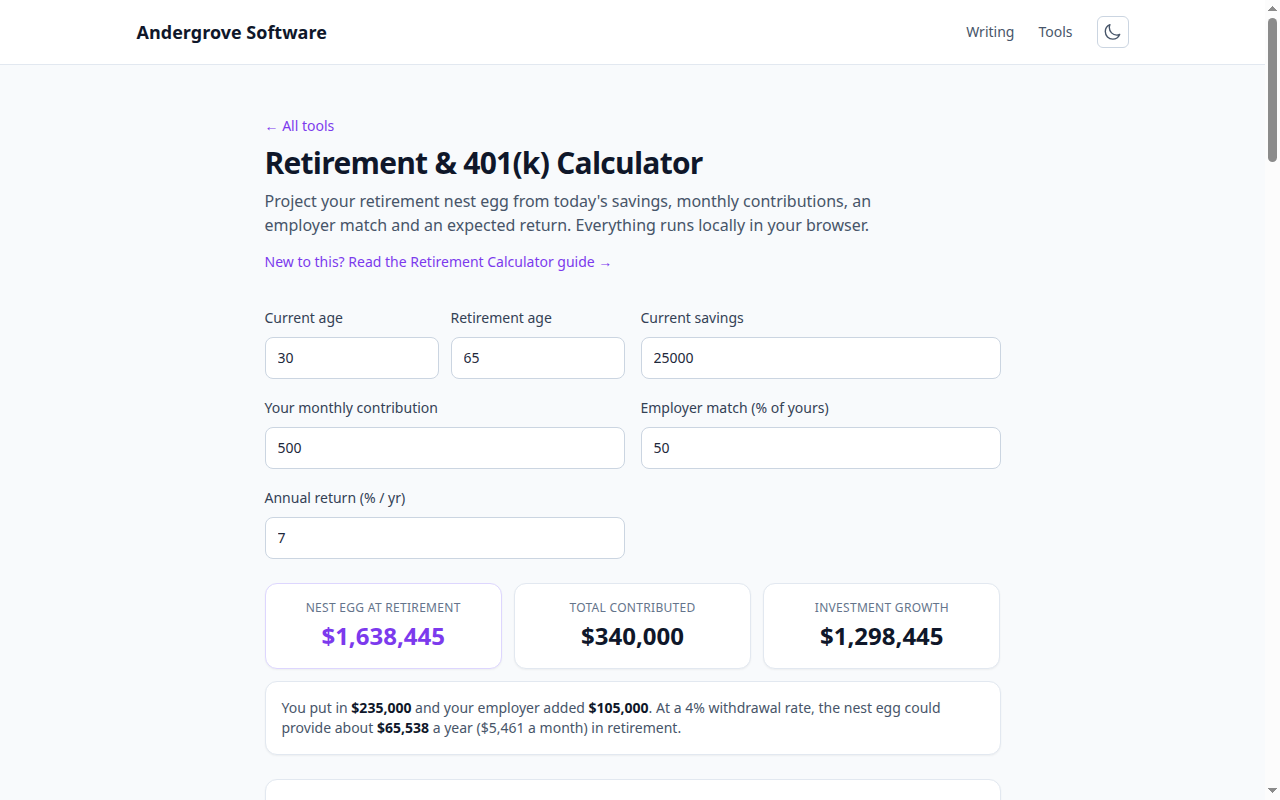
What the 4% rule says
The 4% rule states that you can withdraw 4% of your retirement portfolio in your first year, then adjust that amount for inflation each year after, with a high probability that the money lasts about 30 years. If you retire with $1,000,000, that is $40,000 in the first year; if prices rise 3%, you take $41,200 the next year, and so on. The idea is that a sensibly invested portfolio grows enough, on average, to refill most of what you withdraw.
The 25x shortcut
Flip the 4% rule around and it gives you a target. Since 4% is one twenty-fifth, the portfolio you need is simply your annual spending times 25:
Target = annual expenses × 25Spend $50,000 a year? You need roughly $1.25 million. Spend $80,000? About $2 million. This is the fastest way to convert a lifestyle into a savings goal — and it makes clear that cutting your annual expenses lowers the target dramatically, since every $1,000 of yearly spending needs $25,000 saved to support it.
Where it comes from
The rule comes from the "Trinity study" and William Bengen's research in the 1990s, which tested withdrawal rates against decades of historical US stock and bond returns. A 4% inflation-adjusted withdrawal survived almost every 30-year period tested, including retirements that began just before major crashes. It is an empirical rule of thumb, not a law — which is why the caveats below matter.
The caveats
- Sequence-of-returns risk. A bad market in the first few years of retirement is far more damaging than the same crash later, because you are selling into a downturn. Flexibility in early years helps a lot.
- Time horizon. The 4% figure assumes about 30 years. Retire early — at 45, say — and you may need a lower rate (many use 3.25–3.5%) for a 40- to 50-year horizon.
- It is US-historical. The study used US market history; other markets and the future may differ. Treat 4% as a planning anchor, not a promise.
- Taxes and fees. Your withdrawals may be taxed, and fund fees eat into returns — budget for both.
Getting to the number
Once you have a target, the lever that gets you there is consistent investing over time, powered by compound growth and any employer 401(k) match (free money — always capture the full match first). The retirement calculator projects your nest egg from your current savings, monthly contributions, employer match and expected return, splits contributions from growth, and estimates your income using the 4% rule. It runs entirely in your browser.
Ready to try it? Open the Retirement & 401(k) Calculator →