Can You Actually Improve Your Reaction Time? What Training Does and Doesn’t Change
Every gamer has wondered whether grinding a reflex test will make them faster. The honest answer from decades of research: raw reaction speed is largely hardware, but the things wrapped around it — consistency, readiness, anticipation — are very much trainable, and they matter more in real games than the raw number does. Here’s what actually moves the needle. Get a baseline first with the reaction time test.
Open the Reaction Time Test →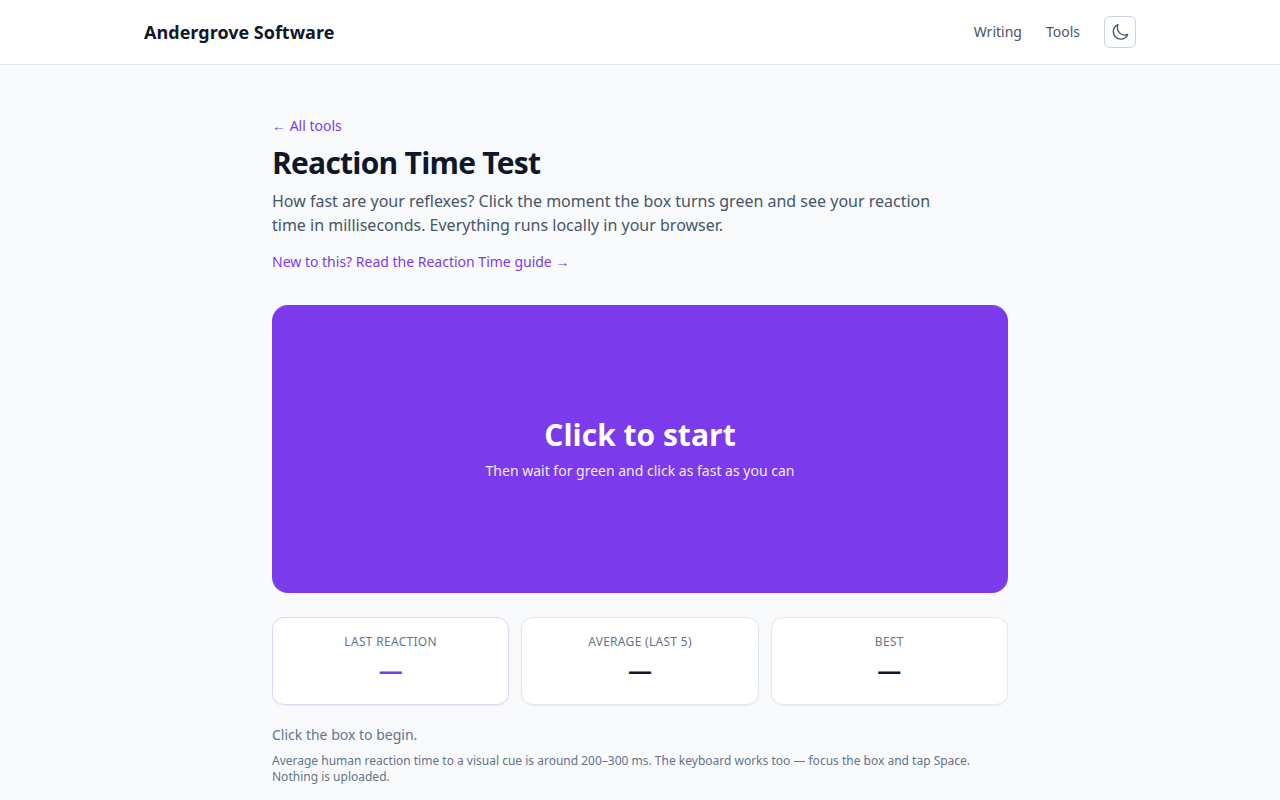
What the number is made of
A simple visual reaction — see the change, click — chains together retinal processing, a decision in the brain, a motor command, muscle activation, and your hardware’s input-and-display latency. Most healthy adults land somewhere around 200–280 ms on a screen test, and a chunk of that is biology with a fixed floor: nerve conduction takes the time it takes. Auditory reactions run a few dozen milliseconds faster than visual ones, which is why sprinters start to a gun rather than a light.
What training genuinely changes
Practicing a reaction task quickly stops making you faster and starts making you tighter: the average creeps down a little, but the spread — the difference between your best and worst clicks — shrinks a lot. That variance is what loses fights: one 350 ms outlier matters more than five 210s. Training also automates the motor side (your click becomes one practiced unit instead of a decision), and it teaches readiness — the alert-but-relaxed state where you’re neither tensed into a false start nor caught flat. Run a set of five attempts and watch the spread, not the best: the test tracks your session and all-time results so the trend is visible.
The everyday factors that swing your score
Before blaming your genes, audit the modifiable stuff — its effect is bigger than any training plan. Sleep deprivation reliably adds tens of milliseconds and multiplies lapses (those embarrassing 500 ms outliers). Caffeine buys a genuine 10–30 ms when you’re fatigued. Alcohol goes the other way, hard. Time of day matters (most people are slowest just after waking and mid-afternoon), and so does temperature — cold hands are slow hands, which is why warming up your aim also warms up your clicks. Same person, different day: 40 ms swing, no training involved.
In real games, prediction beats reflexes
Top players don’t primarily out-react anyone — they out-predict. Holding a crosshair at head height where an opponent must appear converts a reaction problem into a confirmation problem, worth far more than 20 ms of reflex. Pre-aiming common angles, learning timing patterns, and positioning so enemies appear where you expect are all ways of spending game knowledge to buy time no amount of twitch speed can. So split your practice honestly: a reflex test for readiness and consistency, and actual game review for the anticipation that decides most duels. Mechanical clicking speed is a separate skill again — that one lives at the CPS test.
A realistic protocol
Treat reaction testing like a dashboard, not a grindstone: a five-attempt set as a warm-up gauge before you queue, under the same conditions each time (same device, same posture — hardware latency differences between setups dwarf small biological ones). If today’s median is 30 ms off your normal, that’s information about sleep and readiness, not skill regression. Then spend the actual training time where transfer lives: tracking and flicking practice in the aim trainer, and deliberate play. The number takes care of itself when the inputs do.
Ready to try it? Open the Reaction Time Test →