A 15-Minute Daily Aim Routine That Actually Transfers to Your Game
Most people use an aim trainer the same way: click targets furiously for a while, feel busy, improve at nothing. Aim is a motor skill, and motor skills respond to structure — short, focused, repeatable blocks with one goal each. Here is a 15-minute daily routine that transfers to real matches, and the training mistakes that quietly waste months. Run it in the aim trainer.
Open the Aim Trainer →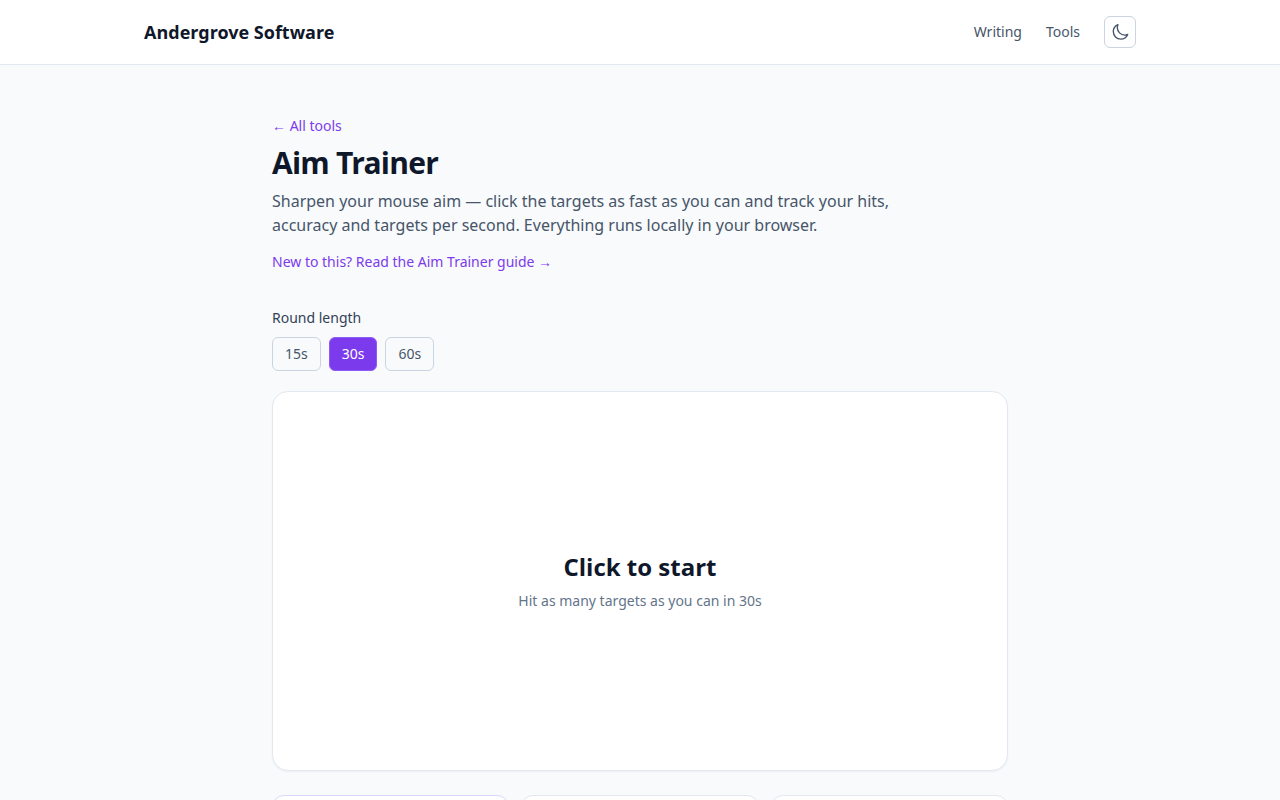
Why structure beats grinding
Randomly blasting targets trains exactly one thing: blasting targets in that trainer. Transfer to a real game comes from isolating components — smoothness, precision, speed, switching — and stressing one at a time, the way musicians practice scales rather than replaying whole songs badly. Fifteen deliberate minutes daily beats a two-hour binge on Sunday, because motor learning consolidates between sessions, not during them.
The routine: four blocks
Minutes 1–3, slow warm-up: big targets, longer round length, moving at 70% of comfortable speed with the sole goal of clean crosshair placement — every shot lands center, zero misses tolerated. Minutes 4–7, precision: small targets, still unhurried; the score that matters is accuracy, and anything under ~90% means you’re rushing. Minutes 8–11, speed: medium targets, now pushing pace until accuracy dips toward 75–80% — that edge-of-failure zone is where speed gains live. Minutes 12–15, switching: shortest rounds, focus on snapping between targets and killing the micro-correction at the end of each flick. The trainer’s target-size and duration settings map straight onto these blocks, and the hits/accuracy/targets-per-second readout tells you which block needs tomorrow’s emphasis.
The mistakes that stall progress
Three habits account for most plateaus. Training at 100% speed all the time — you rehearse missing; speed you can’t control isn’t speed yet. Changing sensitivity every week — aim is a memorized motor map between hand distance and screen distance, and every change throws the map away; pick something sane and give it weeks (the sensitivity converter keeps it identical across games so your practice compounds). Score-chasing — optimizing for one scenario’s leaderboard teaches you that scenario’s quirks, not aim. Judge yourself on the weekly trend of accuracy-at-a-given-speed, which is the only number that transfers.
Making it stick in real matches
Trainer targets don’t shoot back, so bridge deliberately: after the routine, play one warm-up match where the only goal is crosshair placement at head height — not winning, not stats. Expect trainer gains to show up in games with a one-to-two-week lag; motor skills generalize slowly and then all at once. And treat sleep and warm-up as part of the program: reaction and aim share the same biology, and the fastest free upgrade is showing up rested (see what actually improves reaction time). Fifteen minutes, every day, same sensitivity — boring on purpose, which is exactly why it works.
Ready to try it? Open the Aim Trainer →