How to Pick a Web Framework with the Framework Finder
Every "best web framework" listicle ranks the same ten names by vibes. The framework finder works the other way: you state requirements — language, rendering model, what you’re building — and it ranks a curated catalogue against them, explaining each match. This guide explains what the filters mean and how much weight to give each one.
Open the Web Framework Finder →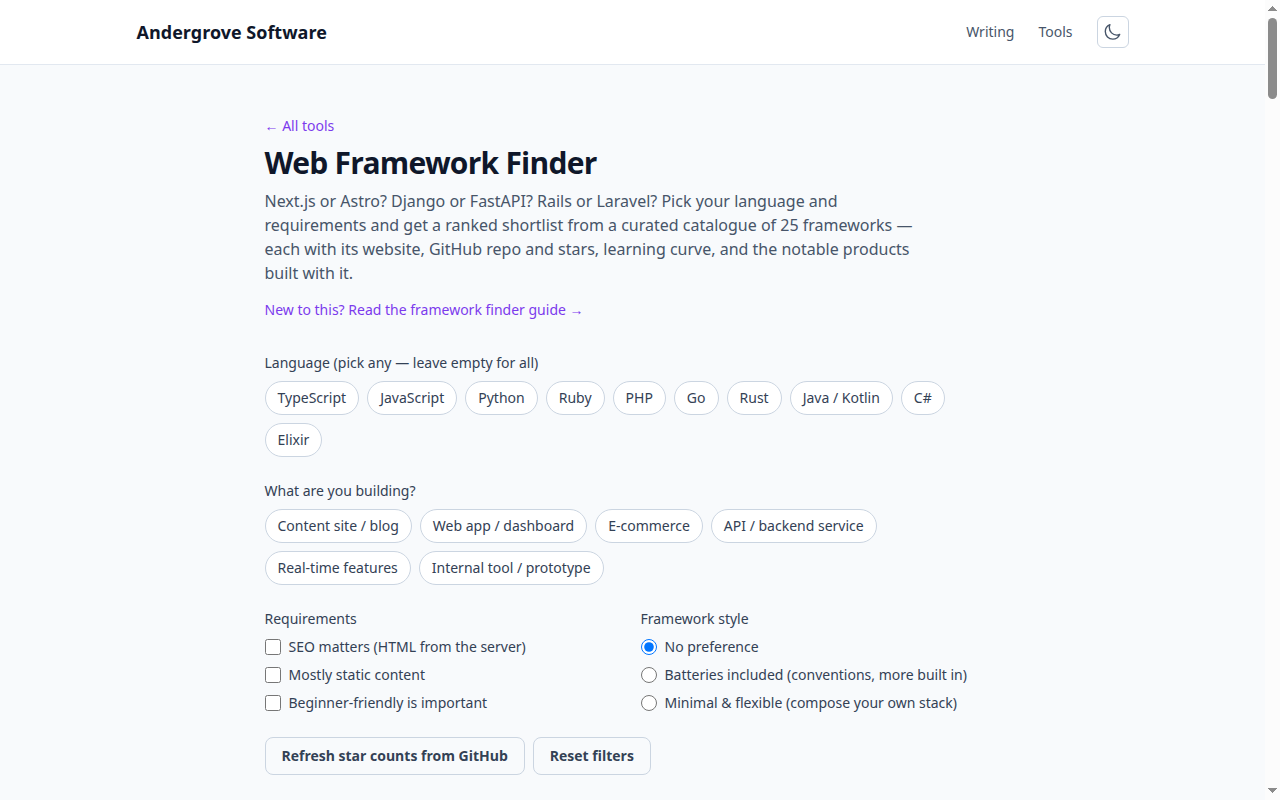
What the framework finder does
The Web Framework Finder holds a curated catalogue of 25 mainstream frameworks — front-end, full-stack and server-side, across ten languages — each annotated with the rendering models it supports, its learning curve, whether it is batteries-included or minimal, its GitHub repository and star count, and notable products built with it. Your selections score and rank the catalogue, and each result card says exactly why it matched. Nothing about your choices leaves your browser.
The language filter is the only hard one
Language is treated as a hard filter — pick Python and the JavaScript frameworks disappear — because it is the one constraint that is genuinely non-negotiable in practice: your team's fluency, your existing codebase and your hiring pool all live in a language. Everything else is scored softly, because most other requirements have workarounds.
If you have no team and no codebase, don't pick a language first. Pick the framework whose model fits your project, and learn its language — the popular ones are all learnable.
What do SSR, static generation and SPA actually mean?
The "SEO matters" and "mostly static" checkboxes map to rendering models, which is the most consequential technical axis:
| Model | HTML comes from | Best for |
|---|---|---|
| SSR (server-side rendering) | The server, per request | Dynamic pages that must be indexable and fast on first load |
| SSG (static generation) | Build time, served as files | Content that changes rarely — blogs, docs, marketing |
| SPA (client-side rendering) | The browser, via JavaScript | Logged-in apps and dashboards where SEO is irrelevant |
| Server-rendered HTML (classic) | The server, templates | Django/Rails/Laravel-style apps — often with HTMX for interactivity |
Ticking "SEO matters" rewards anything that can put real HTML in the first response; ticking "mostly static" rewards static generation and islands-style frameworks like Astro, which ship almost no JavaScript for content pages.
Batteries-included vs minimal
Batteries-included frameworks (Django, Rails, Laravel, Angular, Next.js at the JS end) make the routine decisions for you — ORM, auth, structure — which is a gift for solo developers and deadline projects, and a constraint for teams with strong opinions. Minimal frameworks (Flask, Express, Fastify, React itself) give you a small core and total freedom, which is a gift and a maintenance responsibility. Neither is better; the finder just needs to know which trade you prefer.
How to read stars and "notable users"
GitHub stars are a rough proxy for community size — more stars generally means more tutorials, more Stack Overflow answers, more hirable developers and longer life expectancy. They are not a quality score, they lag (older projects accumulate), and they compare poorly across languages (JavaScript repos star faster than Java ones). The built-in counts are approximate as of July 2026; the refresh button pulls live numbers from GitHub's public API.
"Notable users" answers a different and better question: has this framework survived production at serious scale? GitHub running on Rails or Instagram on Django tells you more about ceiling than any benchmark.
When the finder is wrong
A ranked list can't know three things that should override it: what your team already knows (the strongest predictor of project success), what your organisation already runs (operational consistency is worth a lot), and whether you actually enjoy the framework's style — you will spend hundreds of hours inside it. Treat the shortlist as a well-reasoned starting point for a spike, not a verdict. The fuller decision framework is in how to choose a web framework.
Ready to try it? Open the Web Framework Finder →