Dice Probabilities Every Tabletop Player Should Know
You don’t need probability theory to enjoy rolling dice — but a handful of numbers will quietly make you better at every game that uses them. What advantage is actually worth, why a 7 keeps coming up on 2d6, what 4d6-drop-lowest really produces: here’s the working math, no formulas required. Test any of it empirically with the dice roller.
Open the Dice Roller →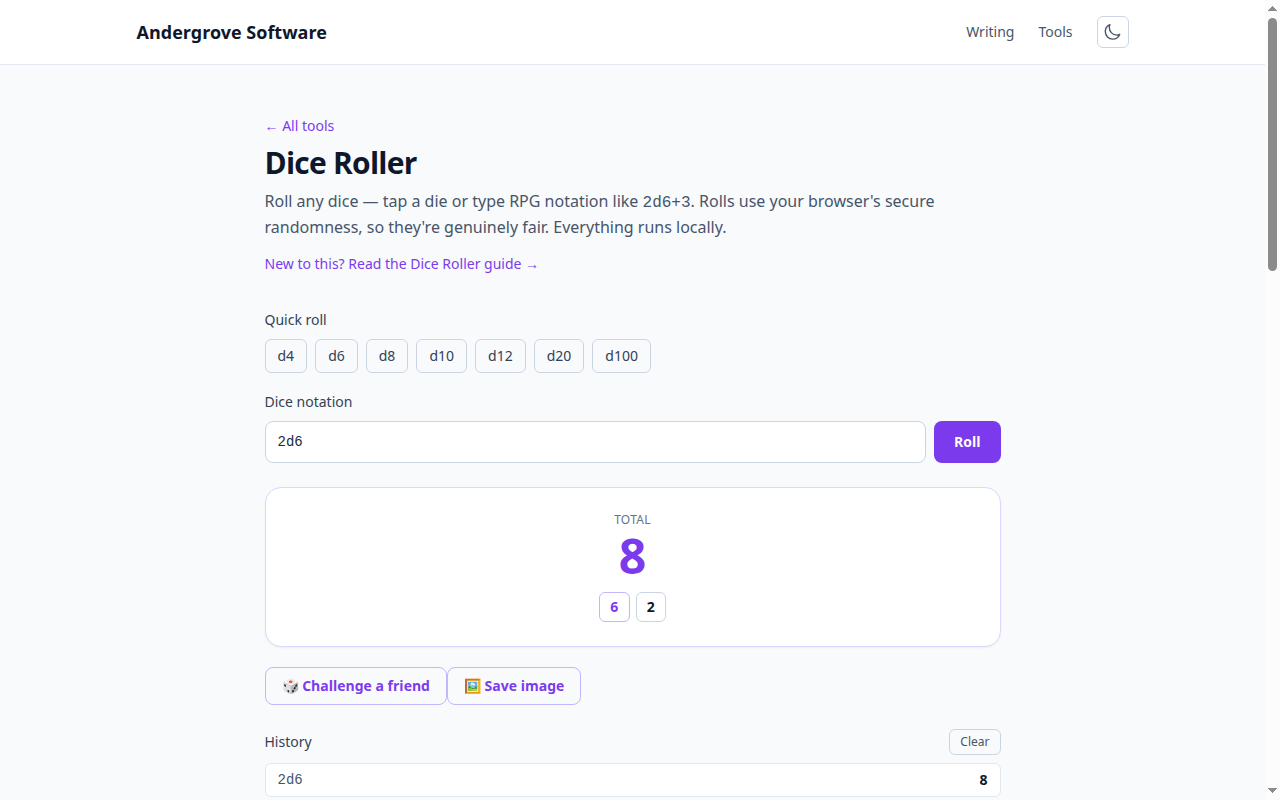
One die is flat; two dice make a curve
A single d20 is uniform: every number, 1 through 20, has exactly a 5% chance, and a 1 is precisely as likely as a 20. Add dice together and the flatness disappears: on 2d6 there are six ways to make 7 but only one way to make 2, so 7 shows up 16.7% of the time and snake eyes 2.8%. This is why d20 games feel swingy (the modifier matters, but chaos reigns) while 2d6 games feel consistent (results cluster around 7, and a +1 modifier near the hump shifts a lot of probability). Neither is better — they’re different knobs for how much luck a designer wants.
What advantage is actually worth
Rolling two d20s and keeping the higher lifts the average from 10.5 to about 13.8 — call it "+3 on average" — but the real story is where the help lands: advantage is worth the most on mid-range targets (when you need an 11, your odds jump from 50% to 75%) and the least on near-automatic or near-impossible rolls. Disadvantage mirrors it exactly, dropping the average to about 7.2. Crits change too: advantage nearly doubles your chance of rolling a natural 20, from 5% to 9.75%. Rule of thumb at the table: advantage beats a flat +2, roughly matches +3 to +4 in the mid-range, and no flat bonus makes an impossible roll possible.
4d6 drop lowest, and other character-creation math
The classic ability-score method — roll 4d6 and drop the lowest die — averages about 12.24 per score, noticeably above the 10.5 of a straight 3d6, and skews the distribution toward heroes: 23% of scores come out 15 or higher, only 10.5% land at 8 or below, and a natural 18 arrives 1.6% of the time — about once per ten characters. Across six scores, most characters land near a total of 73–74, which is why point-buy systems price out around there. Rolling 3d6 in order, by contrast, produces genuinely average people — a deliberate old-school choice, not an oversight.
Streaks, crits and the long session
Per-roll odds compound in unintuitive ways. A 5% crit sounds rare, but across 20 attack rolls you have about a 64% chance of at least one natural 20 — and identically, a 64% chance of at least one natural 1. Someone at a four-hour session will roll a "one in a hundred" event routinely, because hundreds of dice hit the table. The flip side is that dice have no memory: after three straight 1s, the next roll’s chance of a fourth is still exactly 5%, and any feeling otherwise is the gambler’s fallacy collecting rent. When a die feels cursed, roll it a few hundred times in the dice roller and watch the histogram flatten out — cheaper than therapy, faster than superstition.
Notation the roller understands
Beyond plain NdM and modifiers, the roller takes the keep/drop suffixes that cover most tabletop situations:
4d6dl1— roll four d6 and drop the lowest. The D&D ability-score standard.4d6kh3(keep highest three) is the same roll written the other way round.2d20kh1— advantage: roll two d20, keep the highest.2d20kl1— disadvantage: keep the lowest.2d6+3— dice plus a flat modifier, the usual weapon-damage shape.
Dropped dice stay visible but struck through, so you can see the roll that did not count. Whatever you type, the odds panel recalculates the exact distribution for that expression — minimum, average, maximum, and the chance of hitting any target you name.
FAQ
What are the odds of rolling 15 or higher on a d20?
30%: six of the twenty faces succeed. With advantage it becomes 51%, and with disadvantage 9%.
What is the average of 4d6 drop lowest?
12.24, against 10.5 for straight 3d6. An 18 comes up about 1.62% of the time, and a 3 needs all four dice to land on 1 — once in 1,296 rolls.
Is 2d6 better than 1d12 for damage?
On average, marginally: 7 against 6.5. But 1d12 is far swingier — it hits its maximum one roll in twelve, where 2d6 rolls a 12 only one time in thirty-six. Which you prefer depends on whether you want reliability or the occasional spike.
Are the rolls actually random?
Yes. Each die uses your browser's cryptographic random generator with rejection sampling, so every face is exactly equally likely and nothing is uploaded.
Ready to try it? Open the Dice Roller →