How to Make a Debt Payoff Plan That Works
Paying off several debts feels overwhelming until you have a plan, and a good plan is just a handful of steps applied consistently. This guide lays out that plan and the one idea — rolling payments forward — that makes debt disappear faster than people expect. Model your own timeline in the debt payoff calculator.
Open the Debt Payoff Calculator →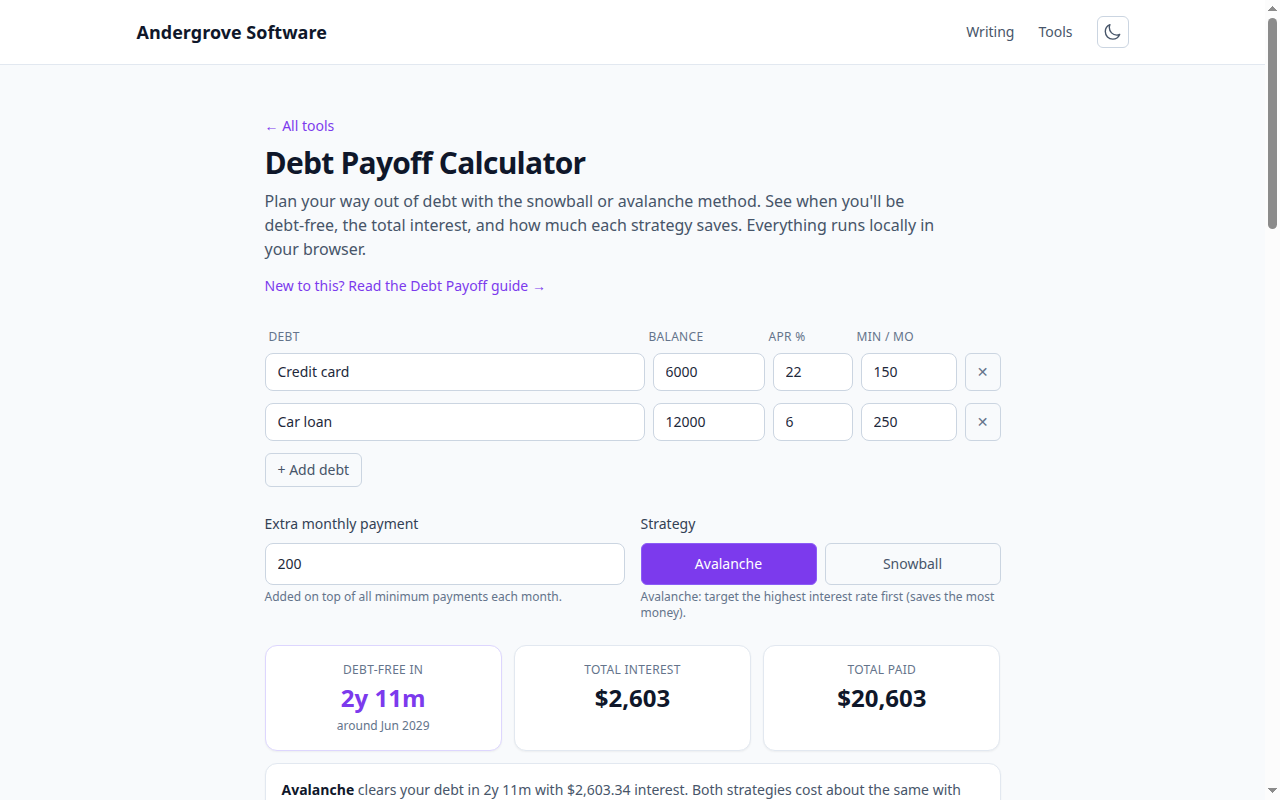
Step 1: list every debt
You cannot plan what you have not written down. List every debt with three numbers: the balance, the interest rate (APR), and the minimum payment. Seeing them together is often the hardest and most useful step — it turns a vague dread into a finite, solvable list. Include credit cards, personal loans, car loans and store cards; leave a mortgage separate as it is usually a different kind of decision.
Step 2: always pay every minimum
Before any strategy, always pay at least the minimum on every debt, every month. Missing a minimum triggers late fees and can wreck your credit score, which raises the cost of everything else. The minimums are the floor; the plan is about where your extra money goes on top of them.
Step 3: pick a strategy for the extra
Put every spare dollar toward one target debt while paying minimums on the rest. Two proven ways to choose the target:
- Avalanche — target the highest interest rate first. This costs the least in total interest and is mathematically optimal.
- Snowball — target the smallest balance first. You clear whole debts sooner, and the early wins keep you motivated.
Avalanche saves more money; snowball is easier to stick to. The best strategy is the one you will actually follow — the full comparison is in debt snowball vs. avalanche.
Step 4: roll payments forward
This is the engine of the whole plan. When a debt is paid off, do not absorb its payment back into spending — add it to what you are already paying on the next target. Your total monthly payment stays the same, but more of it hits principal each time a debt clears, so each successive debt falls faster than the last. This "rolling" (it is what puts the snow in snowball) is why the last debts vanish so quickly, and why paying a fixed total beats paying each minimum separately.
Step 5: stop adding new debt
A payoff plan fails if new debt refills the hole. While you are paying down, avoid new borrowing, and build a small starter emergency fund (even $1,000) so an unexpected bill does not go straight onto a credit card. Once the high-interest debt is gone, redirect those freed-up payments into savings and investing, where compounding now works for you.
See your debt-free date
The debt payoff calculator takes your list of debts and an extra monthly amount and simulates both strategies month by month, showing your debt-free date, the total interest each approach costs, the payoff order, and how much the strategy saves. Seeing a concrete date is often the motivation that makes the plan stick. It runs entirely in your browser.
Ready to try it? Open the Debt Payoff Calculator →